#4820 NEW
Burst pipe — Lindwurmstr. 42
↳ web form
Business systems · Munich
The request is recorded the moment it arrives — not in the evening, if someone remembers. The task sits with the crew, with the shift, with the person out in the field.
Munich · Betriebshaftpflichtversicherung (professional liability insurance)
Burst pipe — Lindwurmstr. 42
↳ web form
Boiler service — Sendling
↳ call, logged
Cooling fault — Giesing
MKM. König · Team Nord
Quote, gutter — Pasing
JSJ. Schmidt · Team Süd
Positioning
A business system is not a design project — it is operational infrastructure. It shapes how leads are handled, how teams coordinate, how data moves, and where control sits — and it must be engineered accordingly.
Before we build, we map your business model, internal workflows, data flows, and technical constraints. Architecture decisions come from how your operation runs — not from trends or templates.
Our focus is on:
The result is not an isolated tool, but a connected operational system — integrated, traceable, and built to scale with the business.
OPERATIONAL SYSTEM MAP
Every company is a system of processes. The costly failures happen at the break points — where the website, CRM, operations, and internal tools hand off to each other and data falls through the gaps.
Website leads are processed manually. Customer data does not enter the CRM automatically.
The operations team does not receive data without manual handoff from CRM.
Task assignment to staff is still manual, without automated routing.
There is no clear real-time picture of processes; analytics lags behind operations.
No critical break
Tap a system block above to check for issues.
DIGITAL INFRASTRUCTURE MODULES
We design and build the systems a company runs on — custom CRM, internal platforms, MVP products, and automated workflows — engineered as connected operational infrastructure.
Digital infrastructure modules
Not marketing pages.
Structured digital platforms connected to the operational processes of a company. These websites integrate with internal systems, automate lead handling and support long-term growth.
Typical capabilities
SYSTEM TYPECustomer interface layer
Internal platforms that support and manage daily operations.
Instead of fragmented tools, companies get a centralized system where data, workflows and teams are connected.
Typical capabilities
SYSTEM TYPEOperational core system
First versions of digital products designed for validation and rapid iteration.
We build scalable MVPs that allow companies to test ideas, attract users and evolve into full platforms.
Typical capabilities
SYSTEM TYPEProduct platform
Automation systems that remove manual work and connect business processes.
Instead of repetitive operations and disconnected tools, workflows become automated and data flows between systems.
Typical capabilities
SYSTEM TYPEAutomation layer
All systems are designed as scalable digital infrastructure — maintainable, integrated and ready to evolve with the business.
IS THIS YOU?
Four situations. Each states what already runs at our side — and what you can open and check.
What we built
One list where everything lands: the request from the website, the phone call and the message — with one click. A field app with the day plan and a checklist. Time tracking that cannot be rewritten after the fact without a trace. A signed work record, confirmed on site with time and date — the entry is assembled from the actual working time and the planned job. A repair history for equipment with documents and prices.
Look at first: mobile care service case — fleet, employee app, signed service recordsStart with: request intake, €800
What runs at our side — and you can open it
kartulirest.de — a restaurant in Germany; the platform was built in 3 months: point of sale and open bills, order handover to the kitchen with fulfilment status, kitchen tasks, cook statistics, menu, recipes and semi-finished items, dish costing with a recommended selling price and break-even, delivery zones with geocoding, reservations and tables, time tracking, payroll with an audit log, financial postings and document recognition, campaigns, customer balance, mobile app. Stock levels are tracked: after cooking, ingredients are written off against the stored recipes, and when minimum levels are reached the system compiles a binding purchase list, and the person responsible buys against it. We deliberately do not place orders automatically — the system builds the list, a human makes the call. The time-tracking module also runs in other restaurants. A single screen across several locations is a design task. With three locations we start with the process review.
kartulirest.de — you can open itLook at first: case studyStart with: process review, €350
What we built
The system calculates the route and the travel time between patients from the map, then refines it with the actual data from the field app. The patient signs for the delivered service on a tablet at the moment of delivery; the record is assembled from the actual working time and the planned service. Fleet, documents, insurance and maintenance sit in one place.
Look at first: mobile care service caseStart with: process review, €350
What we built
Custom manufacturing, USA, anonymised. Before: requests by email, tasks on paper, slow alignment between order and production. Built: a chat with 3D file preview and approval of file and price; automatic routing of orders by metal type and shape; automatic task assembly and stage visibility on a tablet on the shop floor. What transfers is the mechanics — routing an order by material and shape, approving file and price inside the system, stage visibility. We do not transfer industry experience in metal construction or food production.
Look at first: made-to-order manufacturing caseStart with: process review, €350
No block claims industry expertise: each one states mechanics you can verify in a case.
THREE PRODUCTS
The tier follows the task, not the size of the company.
€800
One place where requests from the website, from a phone call and from a message all land — with one status, one owner and one notification.
First release from 7 working days
What is included and what is billed separately€2,500
For people who do not work at a desk: the task is opened and closed on site, and the office sees it immediately.
Timeline by scope
How it worksfrom €6,000
When a process no longer fits in one person’s head: the process itself is rebuilt, not just request intake.
Timeline by scope
What this tier coversDevelopment process
Every project follows a clearly defined methodology. Transparent phases, traceable decisions, and documented outcomes.
Structure reduces risk — and creates predictability.
We define requirements, objectives, and technical constraints. Without a clear starting point, no solid architecture can emerge.
Structure, user flows, and system logic are defined before design begins.
Reduced, functional design — developed from structure, not overlaid on it.
Clean code, stable backend structures, and scalable systems.
Performance, security, and compatibility are systematically verified.
Long-term support and controlled evolution of the platform.
References
Operational systems are judged by outcomes — fewer manual handoffs, faster processing, and real-time visibility — not by visuals.
Selected platforms we designed and shipped, with the operational results they delivered.
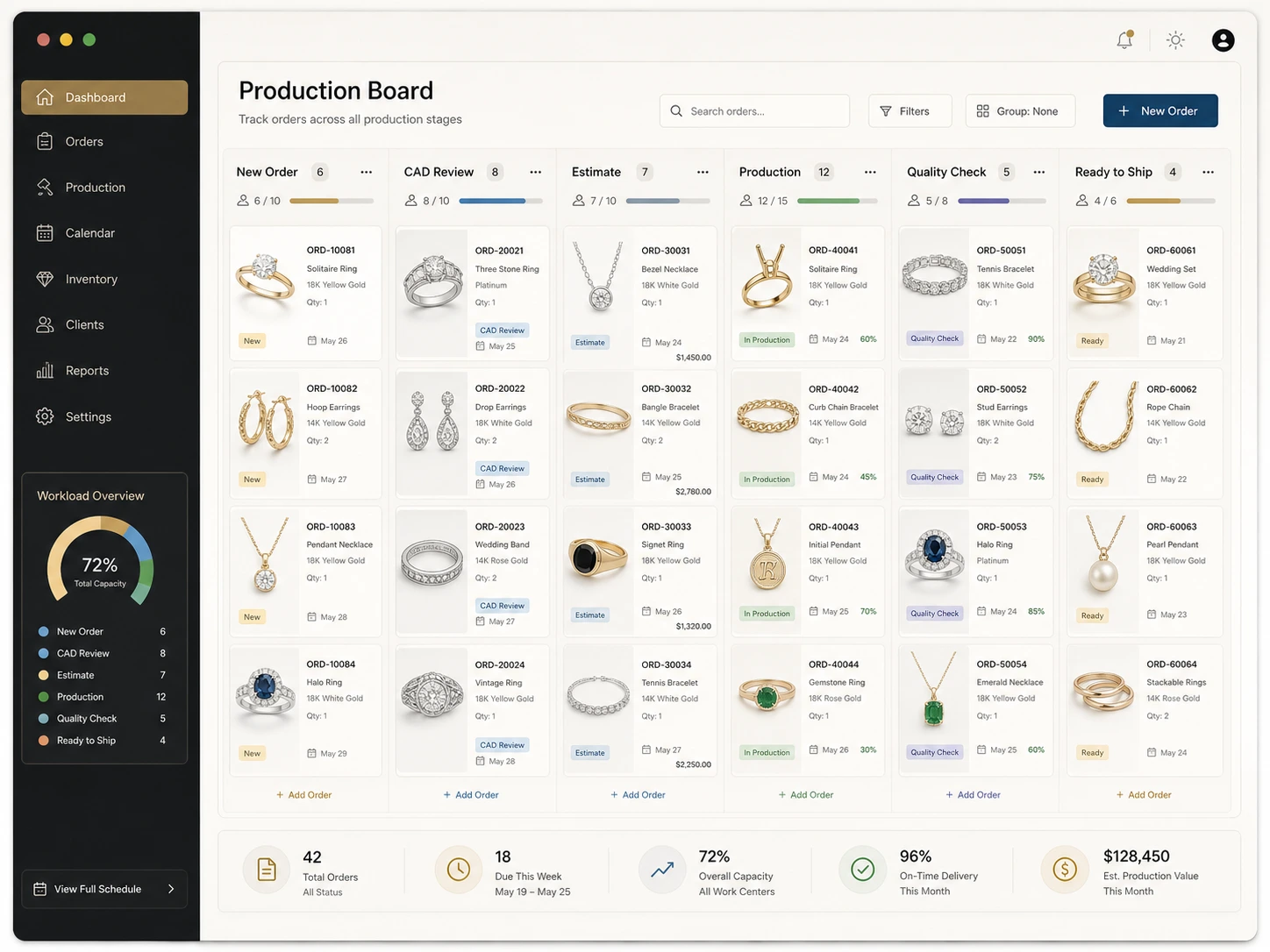
Custom CRM · Workflow Automation · Client Portal · Manufacturing / Jewelry
A centralized system for managing jewelry production, orders, client communication and billing across a unified digital workflow.
Web platform + client application
Scalable cloud infrastructure
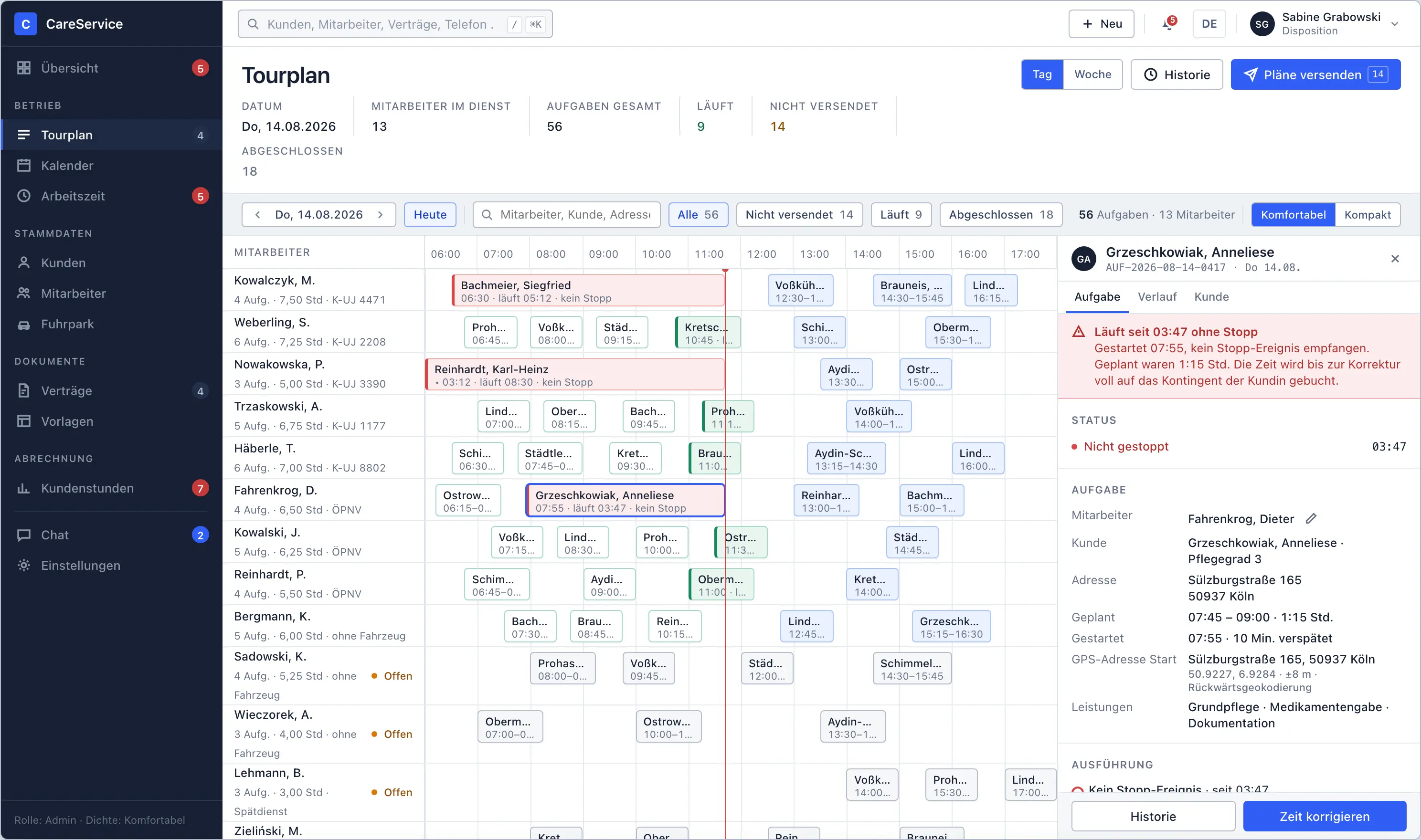
Operations CRM · Tour Planning · Workforce App · Healthcare / Ambulatory Care
A centralized operations platform for managing field workforce, daily tours, time tracking, contracts, fleet management and internal communication within a care service organization.
Operations CRM + mobile workforce app
Real-time infrastructure with modular backend
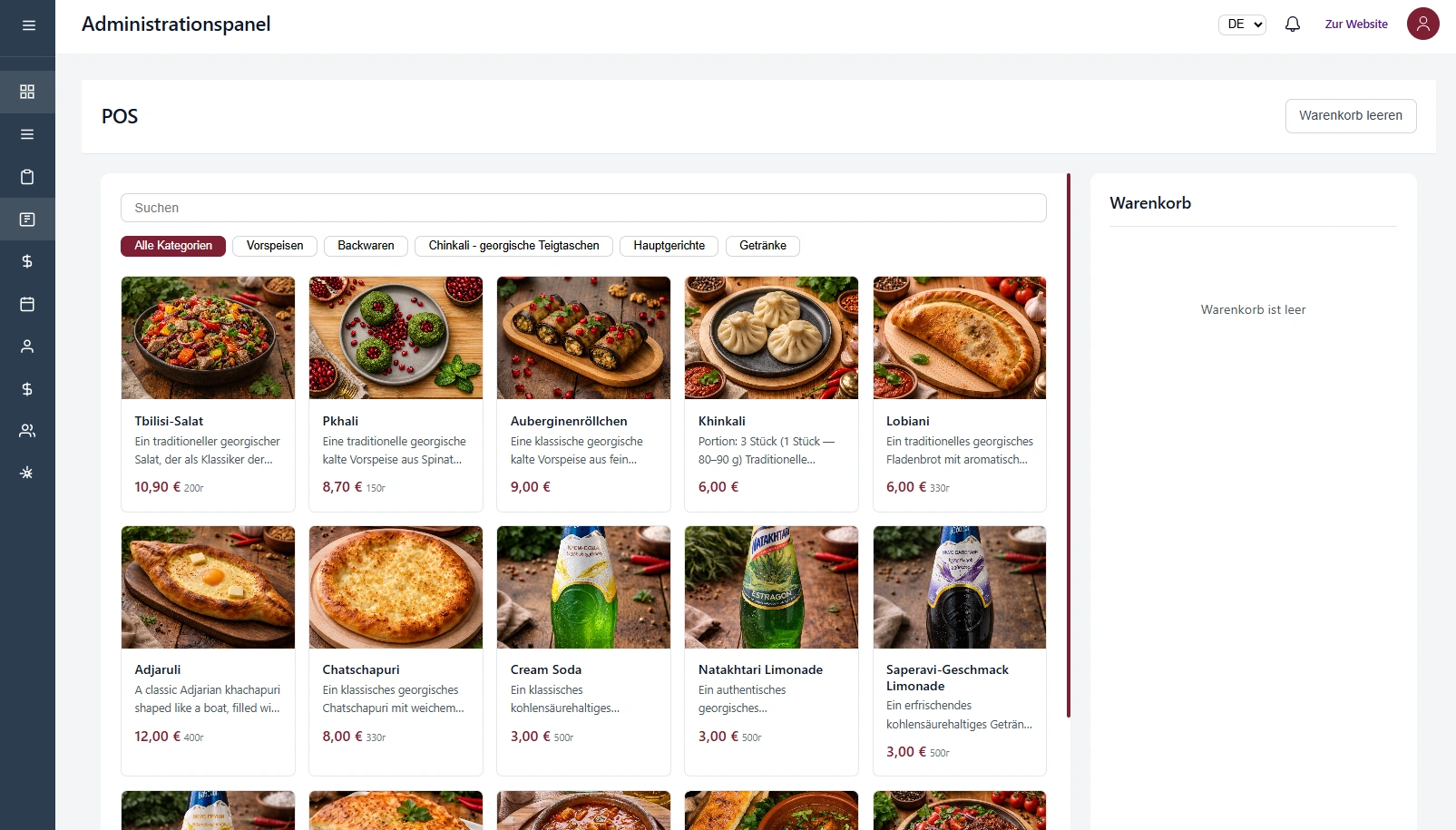
Online Ordering · Reservations · Admin System · Costing · Hospitality / Restaurant
A full-stack platform combining public ordering, reservations and real-time communication with a complete restaurant operations system including kitchen workflow, POS and recipe costing.
Public ordering platform + operations admin system
Real-time infrastructure with modular backend
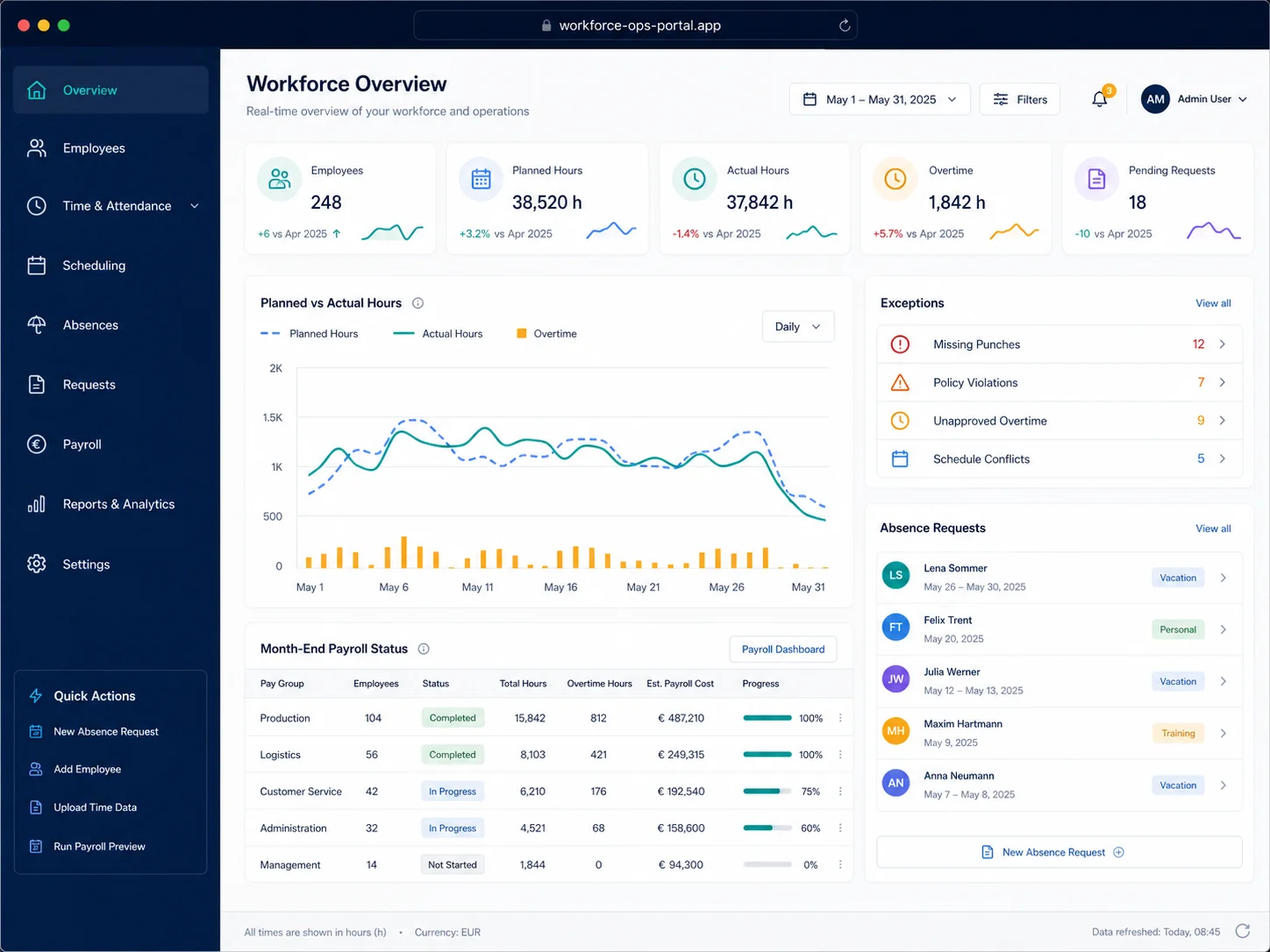
Germany-ready Time Tracking · Industry Workflows · Payroll Integrations · Cross-Industry Workforce Operations
A single workforce platform for Germany: time records, absences, corrections, documents, self-service and payroll-ready exports instead of spreadsheets and manual month-end reconciliation.
Web portal + mobile access + approval workflows
Central workforce backend with rules and export layer
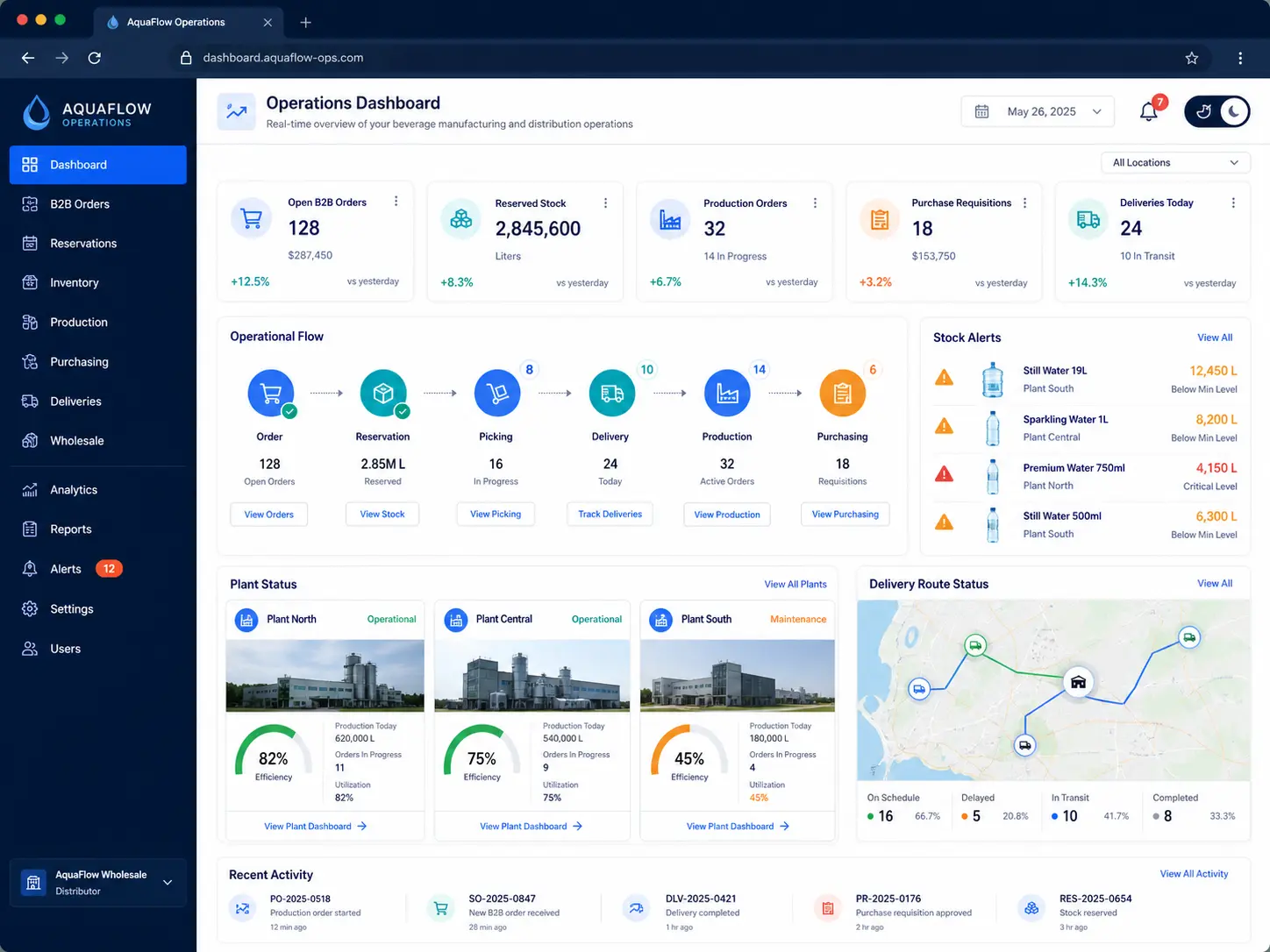
B2B Ordering · Stock-Driven Production · Piece-Rate Payroll · Beverage Production / Wholesale
Three bottling plants and the wholesaler distributing their output on one process model: a B2B account per outlet, invoice and delivery note raised in the ordering transaction, and a stock level that raises the production order and the purchase requisition by itself.
Internal systems per plant and for the wholesaler
Public catalogue with a B2B account per outlet
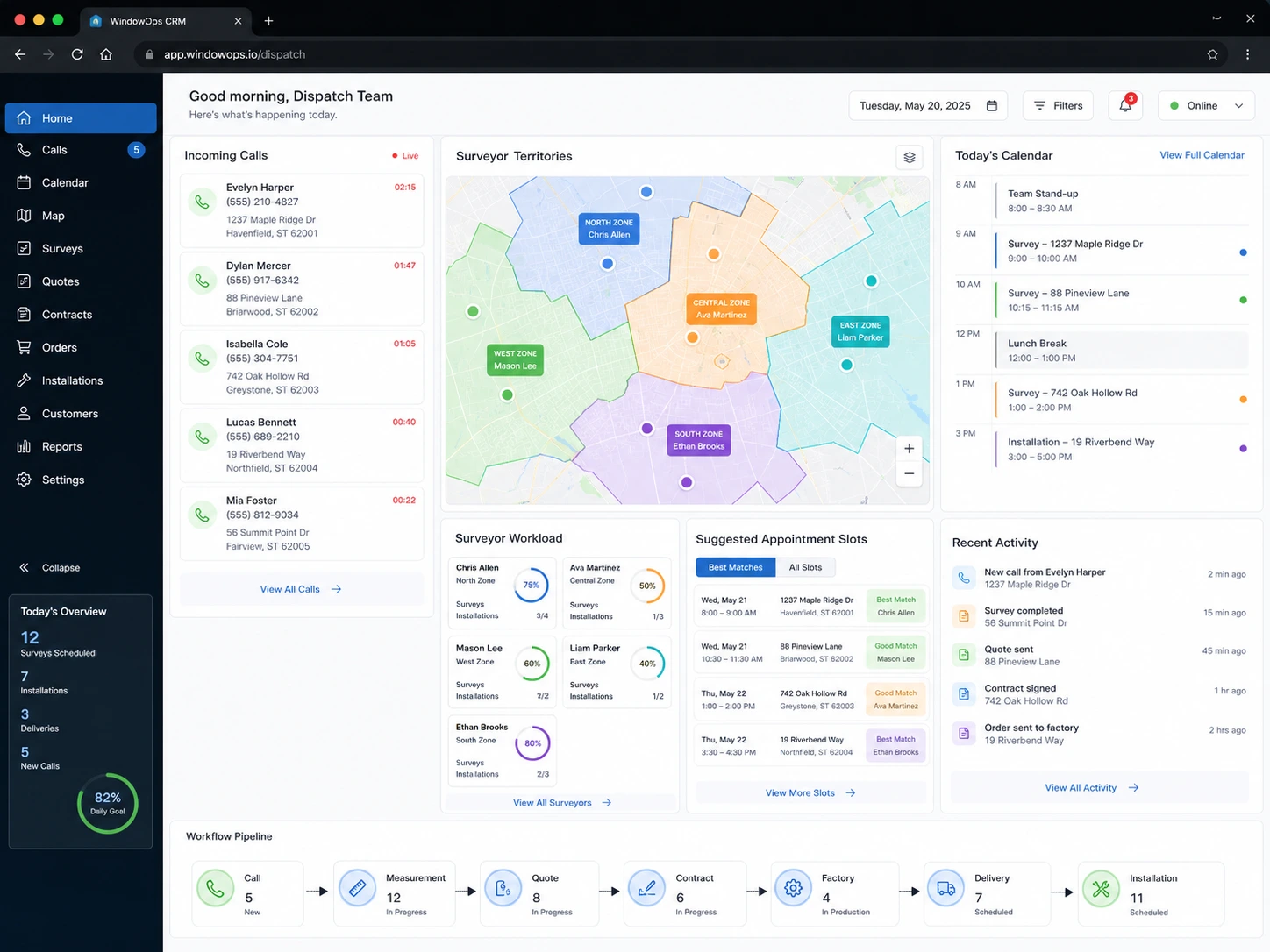
CRM with Telephony · On-Site Pricing and Contract · Factory Integration · Construction / Window Installation
Measurement, a binding price, the contract and the deposit inside one customer visit: the surveyor's tablet prices against the plant's own parameters, and the order reaches the factory and comes back as production stages without being re-entered.
CRM with telephony + tablet application for the surveyor
Two-way integration with the manufacturing plant
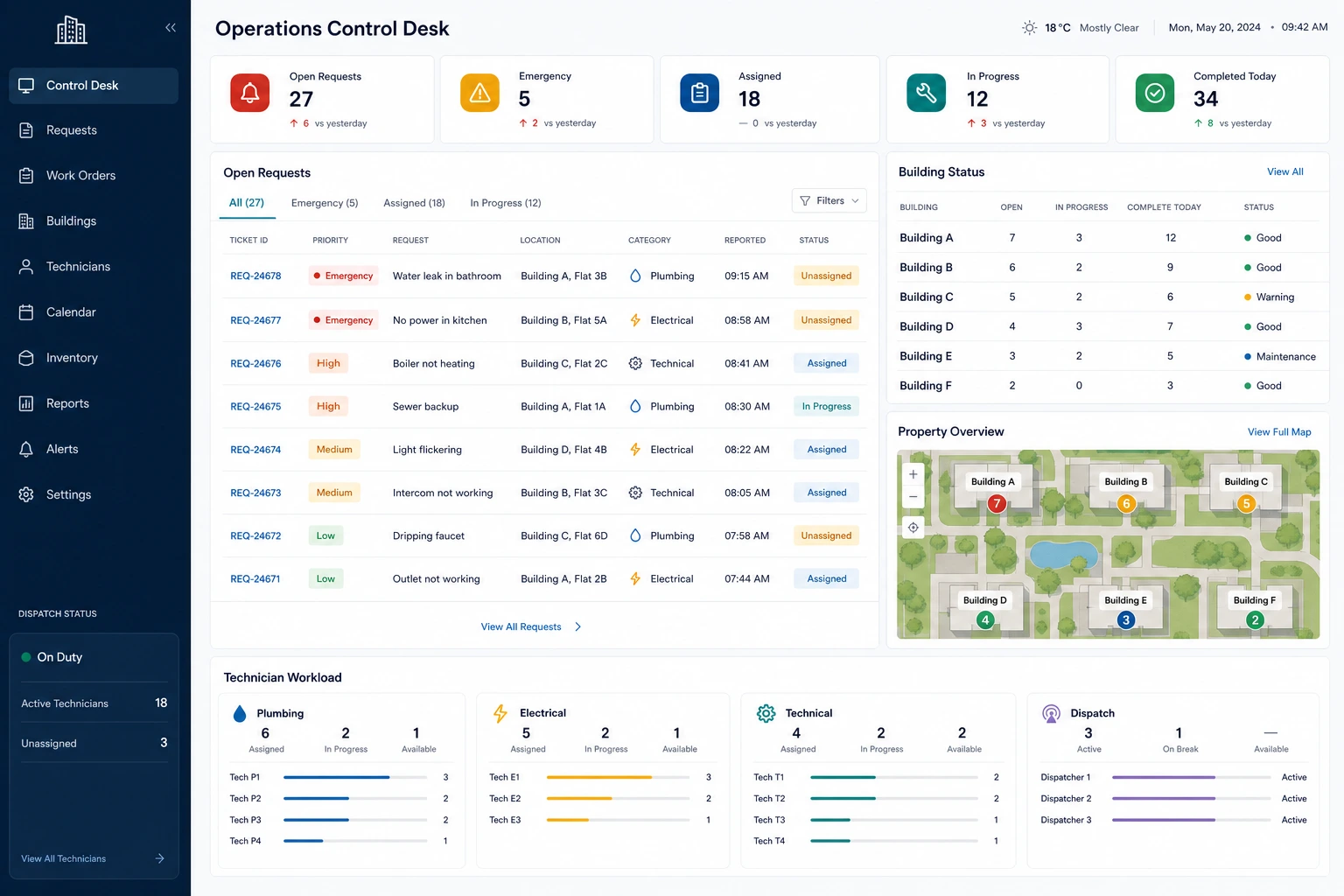
Control Desk · Resident App · Digital Voting · Property Management / Residential
Two connected halves working on the same building and flat data: an internal control desk where a fault report arrives with its building, flat and contact already attached, and a resident account carrying billing, payment, chats and voting.
Internal control desk + resident application on the same building data
Role model per trade and per building
APPLICATION DOMAINS
We design digital systems for companies where operations, processes and data must work together reliably.
Scheduling, staff coordination, field visits and regulatory reporting create complex operational workflows that require structured digital systems.
Typical systems
Fleet operations, route planning and shipment tracking require real-time coordination between dispatchers, drivers and internal systems.
Typical systems
Production workflows, order tracking and supplier coordination require structured operational systems that connect production, clients and internal teams.
Typical systems
Service companies rely on booking systems, technician coordination and client communication that often become fragmented across tools.
Typical systems
Operational teams depend on structured workflows for managing requests, tasks, internal communication and service delivery.
Typical systems
Early-stage products require scalable architectures that allow rapid iteration without compromising long-term system structure.
Typical systems
Our systems are always designed around operational reality — not abstract technology stacks.
SYSTEM DESIGN PRINCIPLES
Every system we build follows a clear architectural logic designed for reliability, scalability and long-term evolution.
STRUCTURED ARCHITECTURE
Systems are designed as modular structures where each component has a clear responsibility.
SCALABILITY BY DESIGN
Infrastructure is designed to evolve with the company and support growth without architectural limitations. Systems can evolve with new services, integrations and increased load without requiring a full rebuild.
OPERATIONAL TRANSPARENCY
Operational data and dashboards are built directly into the system architecture.
MAINTAINABLE SYSTEMS
Codebases are structured for long-term maintainability and team collaboration.
SYSTEM INTEGRATION
Platforms are designed to integrate with external services, APIs and internal tools.
AUTOMATION FIRST
Manual operations are replaced with automated workflows wherever possible.
RESEARCH
Perspectives on system architecture, digital infrastructure and building scalable business platforms.
Many companies implement CRM systems expecting operational improvements. But without proper architecture and process design, CRM becomes just another disconnected tool.
Read articleWhy fragmented business data breaks operations—and how to design a single source of truth.
6 min readScope, limits, and fit when standard CRM is not enough for day-to-day operations.
7 min readHow companies remove manual processes with system integration.
5 min readSYSTEM ANALYSIS
Many companies accumulate digital tools over time — websites, CRM systems, spreadsheets, internal services and third-party platforms.
Without a clear architecture these systems become fragmented and inefficient.
We start new projects by analyzing how the digital infrastructure of a company actually works.
We review the current digital ecosystem of the company — websites, CRM systems, internal tools and external services.
We analyze how information flows through the business: leads, operations, customer data and internal workflows.
Based on the analysis we propose a structured system architecture designed to improve efficiency and scalability.