Property management / Building services
Ten buildings, one control desk, one resident app
Control desk · Work areas per trade · Billing and online payment · Voting
A manager looked after more than ten apartment buildings: grounds, maintenance, emergency service, billing and communication with residents. What was built is a platform in two halves — an internal control desk with a work area for each trade, and an app where the resident sees their bill, reaches the emergency service and takes part in votes.
Starting point
The company looked after more than ten apartment buildings: grounds maintenance, technical upkeep of the buildings, emergency callouts, billing towards residents, and management of its own staff.
The work was split across trades that had almost no shared view. A report reached somebody, was passed on, and afterwards was hard to trace: who took it, which building, which flat, what came of it. During a fault that is precisely the expensive question.
So what was built was not property management software in the narrow sense, but a platform in two connected halves: the internal control desk and the resident application. Both work on the same building and flat data.
Project scope
- Internal side: staff management, time recording, tasks, per-building reporting, internal document management
- Control desk for incoming fault and emergency reports tied to building, flat and contact
- Dedicated work areas for plumbing, electrical, technical staff, building supervisors and dispatchers
- Support channel for resident enquiries during normal operation
- Resident app: billing, online payment, history, notifications
- Chats per building plus a direct channel to the management company
- Digital voting on matters concerning the building
System architecture
The platform has two sides working on the same data: management sees the building, the resident sees their flat. There is no phone note between them.
- Control desk — Incoming reports arrive in one view: building, flat, contact and type of fault — burst pipe, water outage, electrical, emergency, fire risk. The dispatcher responsible for that building sees the report the moment it arrives.
- Work areas per trade — Plumbing, electrical and technical staff each have their own area with their own jobs. A report is handed from the control desk to the trade instead of being passed on by phone.
- Building and staff management — Tasks, time recording, per-building reporting and internal document management sit on the same building data as operations.
- Resident account — Service and management charges, online payment, history of charges, and notifications.
- Communication — Two levels: a chat per building for residents among themselves, and a direct channel to the management company.
- Voting — Matters concerning the building are put to a digital vote; residents vote from their account.
Core functions
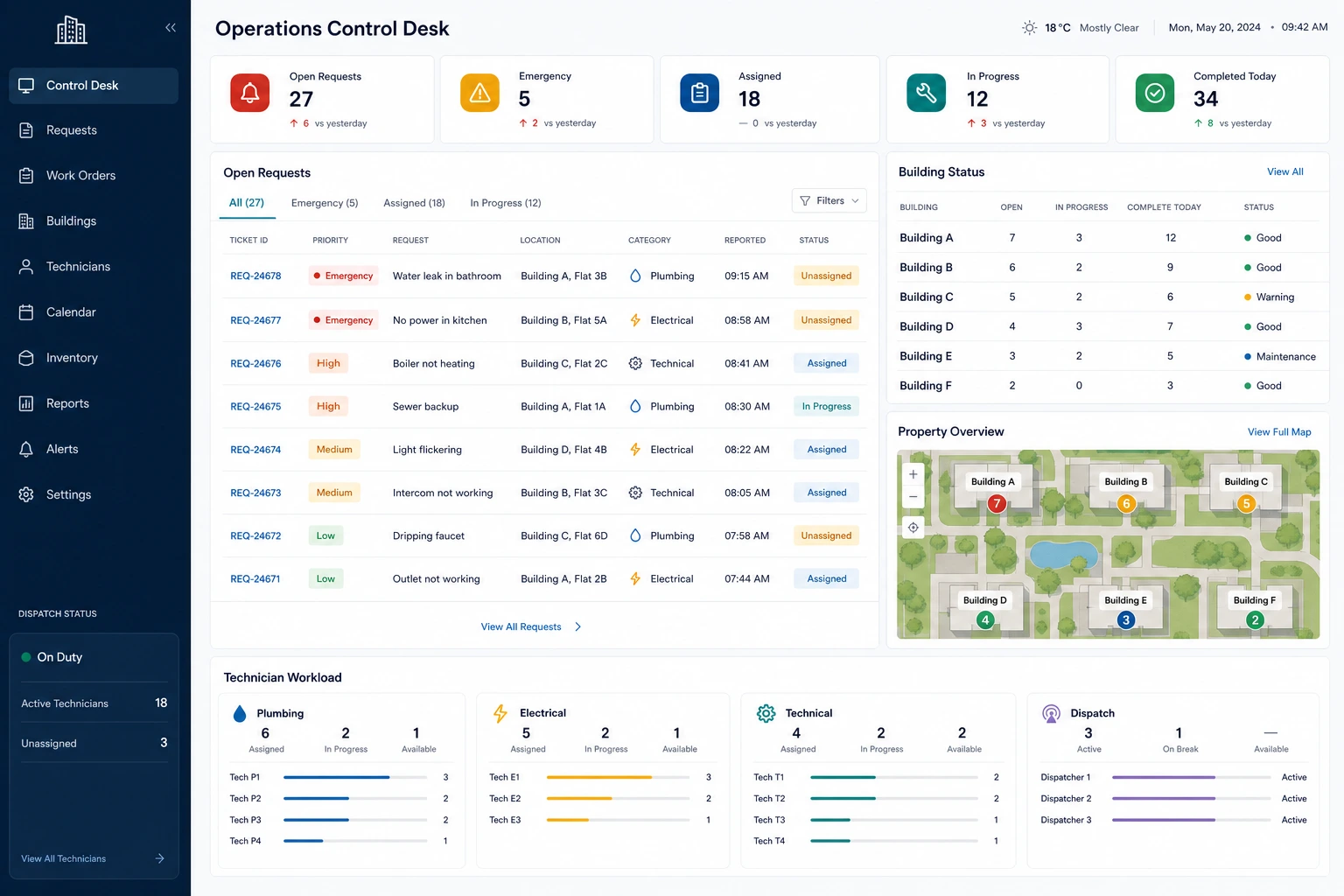
An emergency report is a row, not a phone call
The resident picks the type of fault in the app. The dispatcher responsible for that building immediately sees which building and which flat the report came from, who raised it and what it is about. It then goes to the responsible trade — traceable, with a timestamp.
Every trade has its own area
Plumbing, electrical and technical staff do not work from one shared list but in their own area with their own jobs. The state of a building and the load on each trade stay centrally visible.
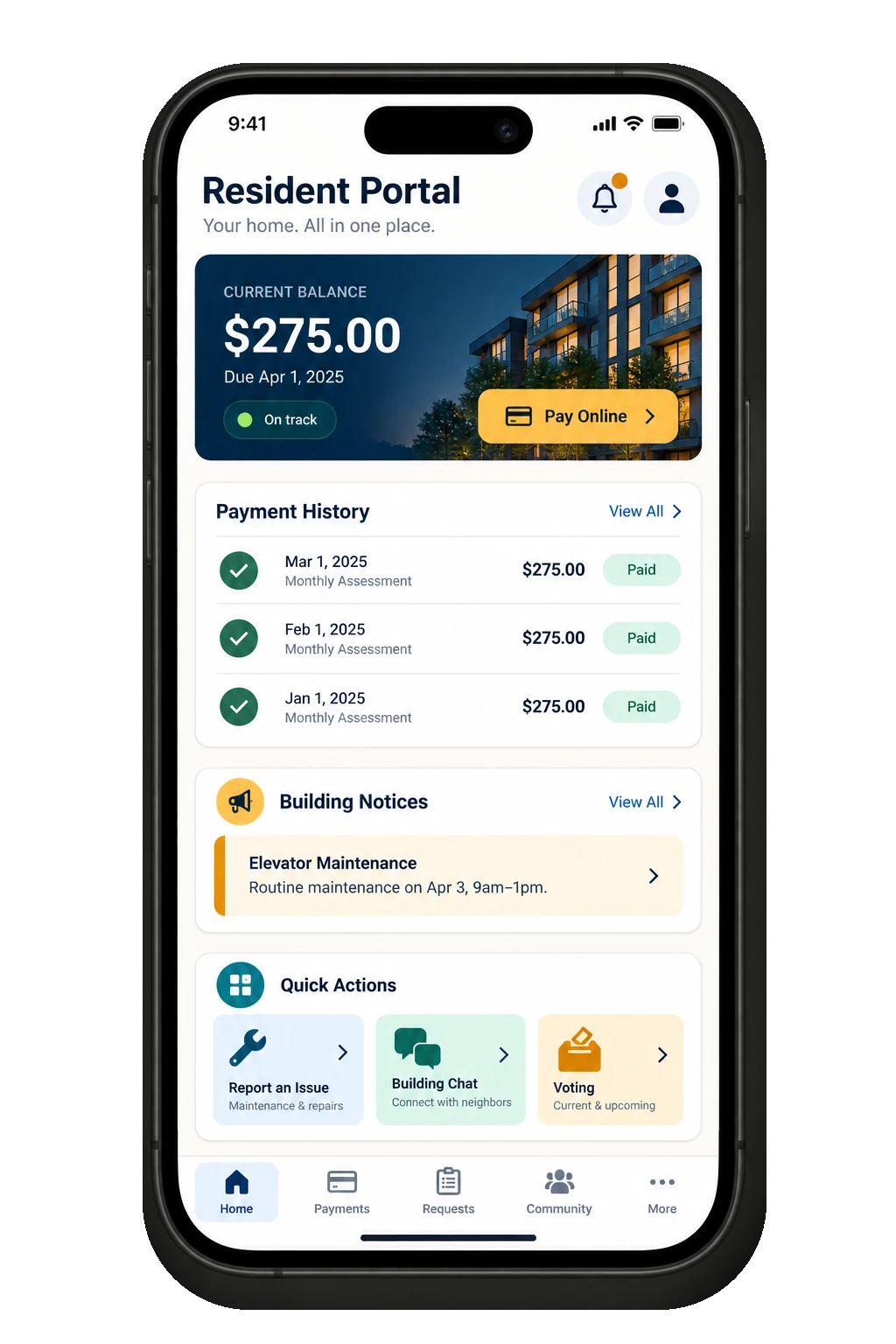
The bill sits with the resident, not in a letterbox
Charges, history and payment sit in the resident's account, and payment is made online. Questions about a bill land in the same channel as the bill itself.
Two levels of conversation instead of one hotline
The per-building chat carries what residents settle among themselves. The direct channel carries what the management company has to act on. Keeping them apart is what keeps the control desk free for what belongs there.
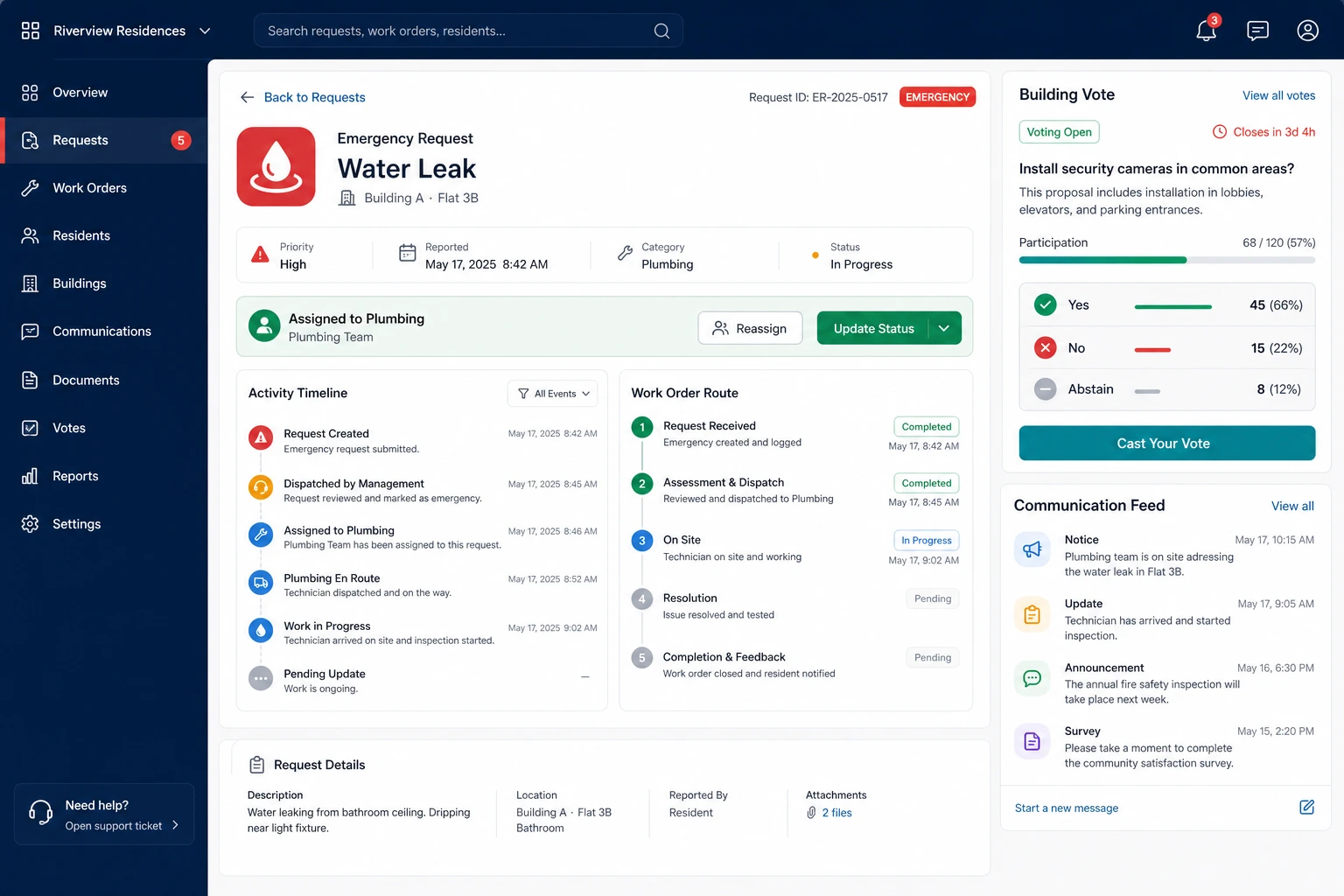
Voting without a paper round
Matters concerning the building are raised digitally and answered from the resident account. That moves part of the decision-making out of a paper circulation and into a traceable procedure.
Technical implementation
Backend
- Laravel (PHP)
- REST API between control desk and resident application
- MySQL data model for buildings, flats, reports and jobs
- Role model per trade and per building
Frontend
- Vue.js for the internal work areas
- Resident account with billing and payment
- Per-building chats and a direct channel
Operations
- Reports tied to building, flat and time
- Time recording and per-building reporting
- Internal document management
Result
Faults, maintenance, billing and communication sit on the same building and flat data. A report is attributable from the moment it arrives instead of disappearing between phone calls.
- Control desk with building, flat and contact context from the moment a report arrives
- Dedicated work areas for plumbing, electrical and technical staff instead of one shared list
- Billing, payment and history in the resident's account
- Separate channels for neighbours and for the management company
- Digital voting on matters concerning the building
- More than ten buildings managed on one platform
What this case does not cover
- The platform was not built under German condominium law. The mechanics — control desk, trades, resident account, voting — transfer; the formal requirements for service-charge statements, budgets and resolutions under the German WEG do not transfer automatically and would have to be modelled specifically for a German deployment.
- No interface to an existing German property management product. Whether such an integration is possible depends on whether that product has an API.
- The client is not named. What is described is the mechanics of the delivered platform.